
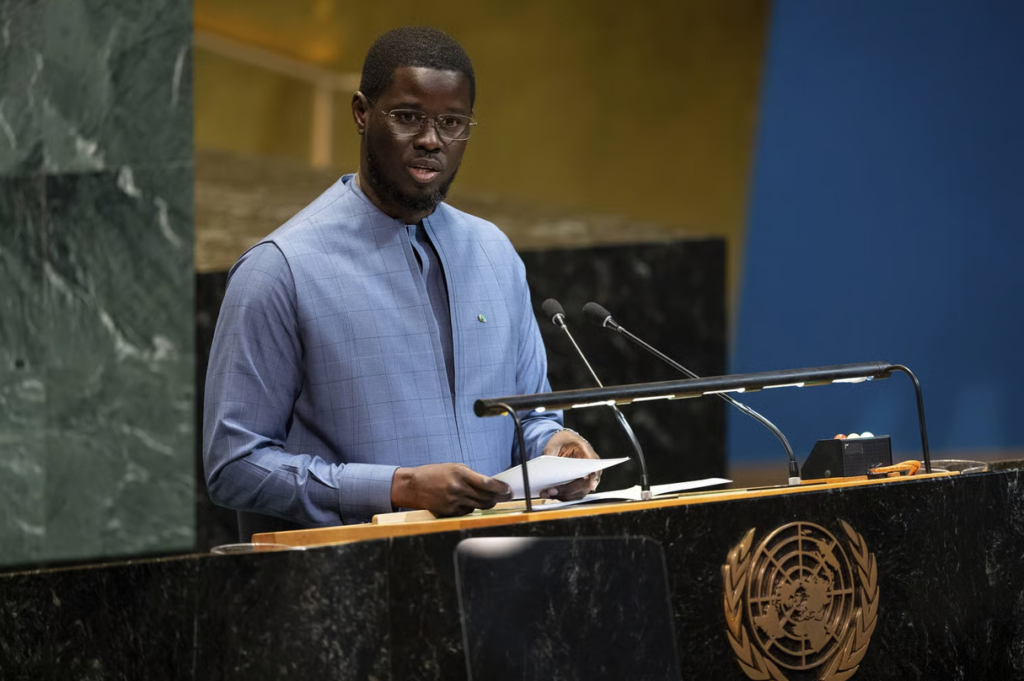
The Senegalese President delivered a memorable speech on climate change on September 24 during the 80th session of the United Nations General Assembly, which reinforces CRADESC in its fight for a just and equitable energy transition.
From the outset, Bassirou Diomaye FAYE emphasized that “climate change is not only a threat, but an existential issue, a reality that hits hardest those who contribute the least, such as Africa with less than 4% of global emissions.”
Faced with this reality and the African populations who live with the consequences that arise from it (drought, floods, coastal erosion, and food insecurity), he reaffirmed Senegal’s commitment to the Paris Climate Agreement and called for “a fair and equitable climate transition through the use of our available resources for universal access to electricity and the initiation of competitive industrialization.”
On the issue of financing, Mr. Faye indicated that the fight against climate change will undoubtedly require substantial funding for adaptation, the simplification and access to the climate fund, as well as the guarantee of technology transfers. He welcomed the creation of the fund to address loss and damage and called for the mobilization of international solidarity to gather these resources in order to finance operations on the ground.
CRADESC advocates for a just and equitable climate transition. Through its Capacity Building of Non-State Actors (RECANE) project for the implementation of the Just Energy Transition Partnership (JETP), it equips civil society organizations, trade unions, NGOs, and the media. The goal is to strengthen their role in the process to promote their active and structured participation in resource mobilization and in the local ownership of the JETP.
Furthermore, CRADESC calls for transparency and the consideration of local realities in financing, as does its financial partner, the African Climate Foundation (ACF).
Lamine Cissé, Country Manager of ACF, believes that the “JETP is an extremely important opportunity for Senegal (…) to be able to reach 40% renewable energy by 2030, and success will be measured (…) by its ability to concretely improve the living conditions of the population.”








