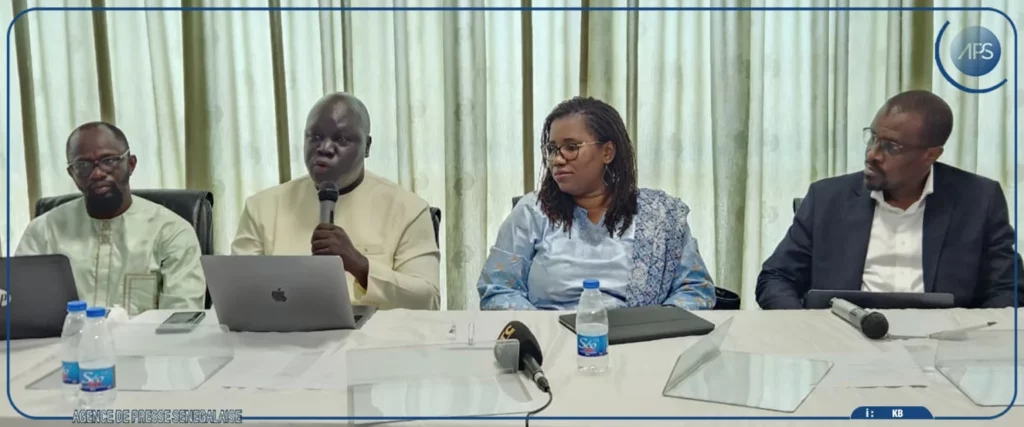
About forty journalists from national and foreign media benefited from a capacity-building session on the just energy transition on July 3, 2025, at the Maison de la Presse, Babacar TOURE, in Dakar. During this day rich in teachings and exchanges of experiences, media professionals gained a better understanding of the stakes and key concepts of the energy transition and the policies implemented by the State of Senegal to promote the emergence of renewable energies.
The beneficiaries, members and representatives of the Association of Journalists for Transparency in Extractive Resources and Environmental Preservation (AJTREPE), the Union of Community and Associative Radios (URAC), the National Initiative of Journalists against Lead (INJCP), the international press, and journalists registered at the Center for Studies of Sciences and Techniques of Information (CESTI), all praised the initiative of CRADESC, for whom the media are essential if Senegal wants to successfully achieve its energy transition as defined in the framework of the Partnership for a Just Energy Transition (JETP).
The workshop is organized as part of the implementation of the project to Strengthen the Capacities of Non-State Actors (RECANE) for a Just Energy Transition in Senegal, with financial support from the African Climate Foundation (ACF). The Country Manager Lamine CISSE reminded about ACF’s mission in supporting the government of Senegal in implementing the JETP, the importance of accurate information, and the partnership that is developing between ACF and civil society, notably CRADESC, before presenting the South African model of the JETP, which is considered a good example.
The Director of CESTI and the Director of the Press House, Sambou BIAGUI, partners of CRADESC in organizing the journalists’ session, emphasized the importance of this activity for media professionals and hoped that this type of partnership could continue.
Mamadou NDIAYE from CESTI particularly accessed his speech on the role of a sentinel that journalists play in the implementation of just policies, and he recalled the missions of CESTI and the important place given to awareness-raising.
The Director of CRADESC, Dr. Fatima DIALLO, spoke about the crucial role of the journalist in the transmission of information, transparency in public debate, participation, and civic monitoring. She also thanked all the partners and participants.
He is the President of the Energy and Mineral Resources Commission at the National Assembly, who conducted the opening ceremony. After reminding that Senegal, like many countries in the South, is already suffering the consequences of emissions for which it is only marginally responsible, Babacar NDIAYE stated that “we have no choice but to reinvent our development paths. The energy transition is an unavoidable route to build a more resilient, diversified economy capable of providing decent opportunities for our youth.” The honorable deputy affirmed, on behalf of his parliamentary colleagues, that the National Assembly will fully play its role of democratic oversight.